
The managed cloud foundation behind CR, TLM, and M2A.
How Coding Reality keeps websites, applications, customer workflows and two operating ventures reliable on one managed technical foundation.
Controlled releases, secure routing, monitoring and tested backups support day-to-day operation.
Customer records, marketing, work tracking, support and invoicing share managed workflows.
The same foundation supports The Live Market and M2 Adverts, as well as Coding Reality.
You cannot manage real ventures on scattered servers and disconnected tools.
Coding Reality manages its own company, The Live Market, M2 Adverts, and client delivery. That requires a repeatable foundation for hosting, deployments, monitoring, CRM, marketing automation, project tracking, support, invoicing, documentation, and workflow orchestration.
CR has to support its own company, TLM, M2A, and client systems without rebuilding hosting, deployment, monitoring, and business operations each time.
Deployments, domains, certificates, monitoring, CRM, marketing automation, support, project tracking, and invoicing all affect delivery quality.
Managing TLM platform workflows and M2A remote tablet operations requires repeatable cloud practices, not ad hoc server changes.
Owned infrastructure. Connected business operations. Managed as one foundation.
Instead of relying on scattered software accounts and manual server work, Coding Reality built and manages its own operating foundation: cloud orchestration, controlled deployments, routing, DNS, certificates, monitoring, backups, private networking, secrets handling, customer data, marketing automation, work tracking, customer communications, invoicing, and service-specific deployment workflows.
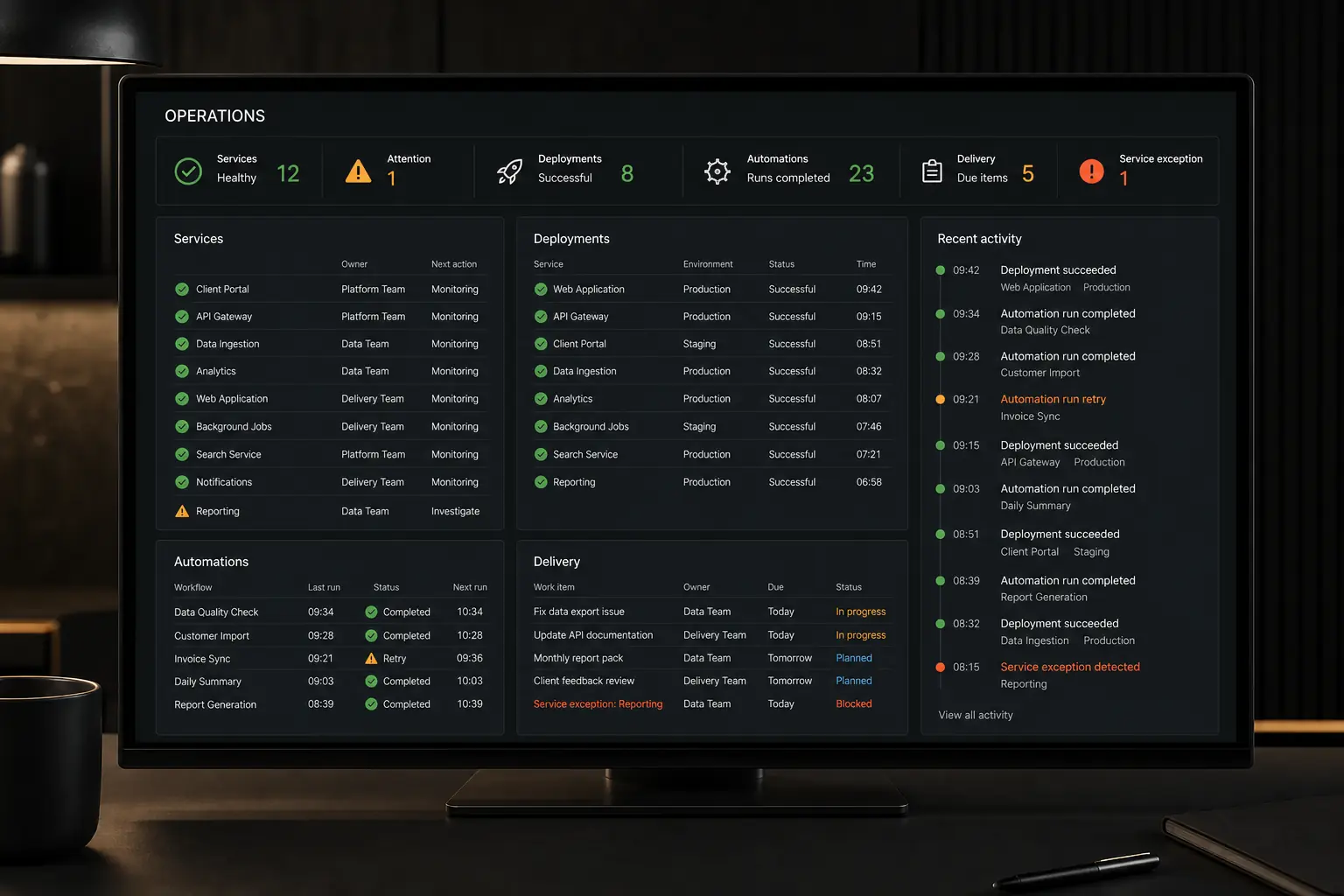
Managed hosting, deployments, service health, and rollback-safe changes
Domains, routing, TLS, private networking, and controlled service exposure
Automated campaigns, lead nurturing, and controlled segmentation
Contact records, opportunity pipeline, and interaction history
Issue tracking, project planning, and time tracking
Email, web enquiries, and messaging in one managed conversation space
Automated invoicing, payment tracking, and financial records
Connects triggers, handoffs, approvals, and automations
These are not separate tools sitting beside separate servers. They are part of one managed operating foundation. CR uses the same cloud, deployment, monitoring, workflow, and business systems layer to run its own operations, support TLM, support M2A, and deliver client work.
What changed when the operating system went live.
The same managed infrastructure practices support CR, TLM, M2A, and client delivery instead of each project becoming a separate technical island.
Customer data, marketing automation, customer communications, work tracking, invoicing, workflow orchestration, and deployment operations work as part of the same managed operating stack.
TLM platform workflows, supplier sync, admin operations, and M2A tablet fleet services all sit on top of the CR-managed cloud and operations layer.
CR sells managed digital operating layers because it uses one every day across real ventures, remote device operations, platform workflows, and client delivery.
Clients get a partner that already operates what it recommends.
Coding Reality does not just recommend managed systems. It runs on them. The CR cloud supports its own business operations, TLM's platform and data workflows, M2A's remote tablet and campaign workflows, and client delivery infrastructure.
When a client works with CR, they are not buying isolated development work. They are getting access to a managed infrastructure practice that already operates real platforms, remote device systems, CRM workflows, automation, monitoring, and delivery processes.
Hosting, deployments, networking, certificates, monitoring, backups, secrets, and service health are managed as a foundation.
Customer data, marketing automation, work tracking, customer communications, invoicing, and workflow orchestration connect the business side of delivery.
The infrastructure is not theoretical. It actively supports Coding Reality itself, The Live Market, and M2 Adverts.
Book a discovery call.
Tell us which digital services your business depends on and where reliability or ownership is unclear. We will outline a practical first review.
+356 7904 5156 · No commitment required · Malta Enterprise support may cover up to 75% of eligible costs for approved projects; eligibility and approval are determined by Malta Enterprise